
RU ACHIEVEMENT
Village Rebranding Competition

Awarded 2nd Prize at Nanao Village
Rebranding Competition
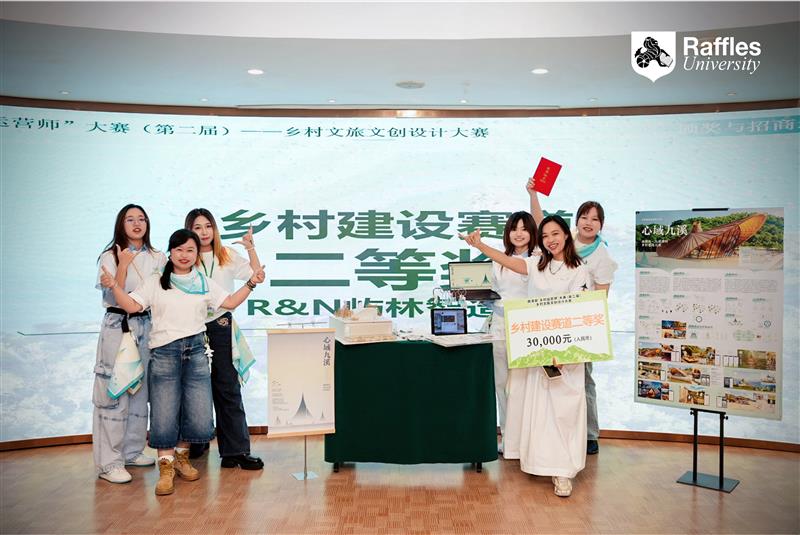
In collaboration with Neusoft Institute (China), Raffles University has been awarded 2nd Prize in the 2nd Nan’ao “Village Rebranding and Reactivation” Competition, a prestigious initiative organised by Guangdong provincial and local governments alongside leading industry partners.
This unique interdisciplinary project brought together students and academic leads from Raffles University’s Faculty of AI and Robotics and Faculty of Arts and Design. Our representative, Team 11, presented a forward-thinking concept titled “心域九溪 JIUXI MINDSCAPE” under the Rural Construction (乡村建设) category, focusing on sustainable AI-enabled cultural tourism. The proposal envisions an immersive, meditative experience where visitors connect deeply with the village’s natural landscape and rich traditions.
The design team strengthened its ability to translate academic and creative knowledge into decisions that are workable under real industry conditions. Working on a live, place-based brief required the team to conduct field-informed research, interpret local constraints, and convert observations into feasible strategies rather than purely conceptual proposals.
Interdisciplinary Collaboration
The project was driven by a 4 member team:
Chan Zhi Ying, Bachelor in Graphic Design (Honours)
Tang Xin Tong, Bachelor in Graphic Design (Honours)
Chong Jun Hao, Bachelor of Information Systems (Honours) in Artificial Intelligence
Loh Min Yu, Bachelor in Information Technology (Honours)
The collaboration model also expanded the team’s interdisciplinary literacy: members learned to communicate across urban planning, AI development, and branding logics, aligning different evaluation criteria into one coherent narrative and deliverable system. The experience of preparing and presenting a real pitch sharpened strategic framing, evidence-based persuasion, and stakeholder-oriented storytelling, especially in an international context where expectations, cultural references, and working norms differ.
The team’s collaboration exemplifies Raffles University’s commitment to cross-disciplinary innovation, combining design, technology, and environmental perspectives into a single cohesive solution.
About the Competition
Portfolio: "The Jiuxi Mindscape Concept"
“心域九溪 JIUXI MINDSCAPE” is designed to merge tradition, nature, and technology:
AI Tourism Experiences: Visitors engage in meditative and interactive experiences that showcase the village’s natural beauty and heritage.
Community-Centric Design: Initiatives include local art, micro-updates to public spaces, and AI-powered cultural engagement.
Sustainable Development: Concepts focus on creating replicable, long-term strategies for village revitalization, including research-driven cultural tourism and smart environmental planning.
Under tight deadlines and cross-country coordination barriers, the design team developed stronger project management discipline—prioritising, integrating feedback rapidly, and maintaining quality control—while also building confidence in navigating ambiguity, negotiating meaning across teams, and delivering professional outcomes that can be implemented beyond the classroom.