
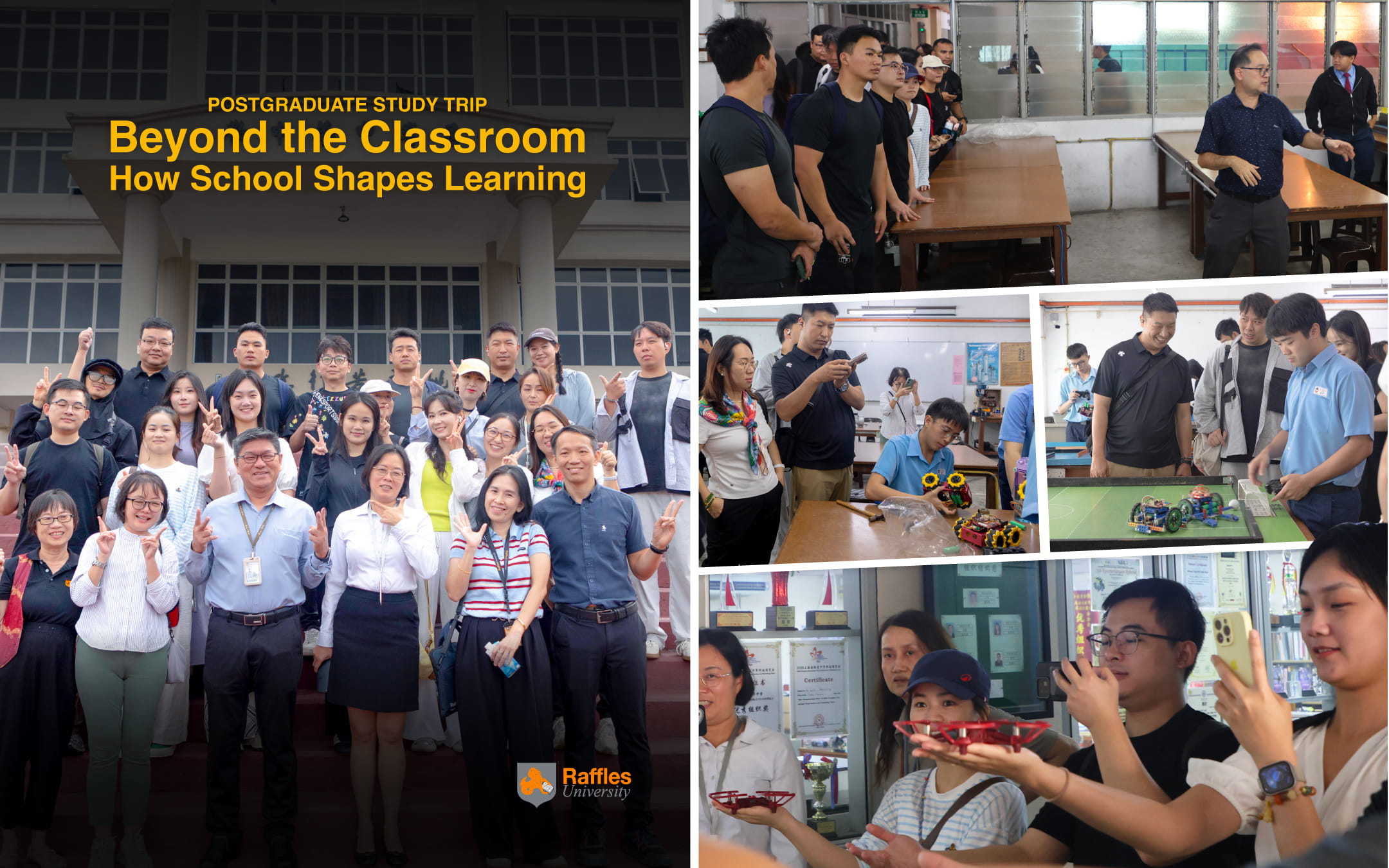
RU Postgraduate Study Trip
Beyond the Classroom: How School Shapes Learning

How do schools shape learning beyond the curriculum? A postgraduate study trip to Chong Hwa High School, Kluang, gave Raffles University students and academic staff the opportunity to explore how learning environments, leadership, and educational philosophy influence education in practice.
On 23 July 2026, Raffles University visited Chong Hwa High School, Kluang, for an academic exchange that brought together educators and postgraduate students to strengthen dialogue between secondary and higher education while exploring different approaches to teaching and learning.
The delegation comprised six academic staff members, including the Vice President, Programme Directors, and Professors, together with 21 Master’s and PhD students. They were warmly welcomed by Principal Lai Chun Seong, Vice-Principals Ho Siao Chieng and Tan Wei Yee, along with the school’s department heads.
Learning in Practice
The visit began with a tour of the school’s Electronics Technology Department, Art & Design Department, and Maker Classroom, where participants gained first-hand insights into its approach to technical and vocational education, curriculum planning, and interdisciplinary learning. The delegation also observed how well-designed learning environments support students’ creativity, technical development, and hands-on learning.
Beyond the campus tour, both institutions exchanged views on a range of educational topics, including the development of independent Chinese secondary schools, teacher recruitment and professional development, curriculum innovation, school funding, holistic education, pathways between secondary and higher education, and the integration of AI into teaching and learning.
Conversations That Shape Education
Throughout the discussions, one idea remained central: learning is shaped not only by curriculum, but also by learning environments, leadership, culture, and educational philosophy. Through meaningful dialogue with school leaders and educators, participants reflected on how these elements come together to create enriching educational experiences.
Chong Hwa High School also shared its ongoing initiatives in AI-integrated teaching, maker education, vocational programmes, international education initiatives, and continuous teacher development. The exchange also identified opportunities for future collaboration in teacher development, educational research, student pathways, AI applications in education, and community engagement.
For Raffles University, the visit reflected the value of learning through observation, dialogue, and partnership, demonstrating that some of the most meaningful educational experiences happen beyond the classroom.